Why does prep work matter more than the paint you choose?
Key Takeaways:
Prep work matters more than paint because surface preparation controls adhesion, and adhesion controls how long a finish lasts. Most early paint failures trace back to skipped preparation, not bad paint. Sound surface preparation can add years to an exterior paint job in Chicago.
Here is the thing people get backwards. They obsess over the paint and barely ask about the prep. But a gallon of the best coating in the world cannot stick to a dirty, chalky or peeling surface. Adhesion is the whole ballgame. If the new coat cannot grip the substrate, it does not matter what is in the bucket.
When a job fails fast — peeling by year two, blistering by year three — the cause is rarely the product. It is the missing groundwork. Loose paint that never got scraped. A surface that never got cleaned. Bare wood that never saw primer. Prep is not glamorous, it’s the part of the job nobody photographs, and that is exactly why some crews skip it to win a cheap bid.
We go the other way. Good surface preparation is how a Chicago exterior gets to that 8-to-12-year window instead of a sad three-year redo. If you want the deeper dive on the painting side specifically, our post on why exterior paint prep work matters most breaks the painting steps down further. This piece pulls back further, to cover both paint and masonry.
Chicago weather raises the stakes on every job
No part of the country is harder on a finish than this one. Our winters throw freeze-thaw cycles at a building dozens of times in a single season. Water sneaks into a hairline crack, freezes, expands, then thaws and does it again. That alone will lift paint off wood, stucco and brick like a bad sticker.
Then summer shows up with heat and humidity, and the whole assembly swings well over a hundred degrees between January and July. Wood, metal and masonry all move at their own pace. A finish has to flex with that movement or it cracks. This is why a flexible, vapor-permeable system beats a hard, cheap one every time — the wall needs to breathe so trapped water can escape.
The real enemy underneath all of it is moisture intrusion. Most failures we open up come down to water getting behind the film through failed caulk, rotted wood or a busted mortar joint. The federal guidance on moisture control in homes says the same thing we tell every client: stop the water first, then finish the surface. For the weather angle on coatings, our guide to how Chicago weather destroys exterior paint goes further.
What does proper surface preparation actually involve?
Key Takeaways:
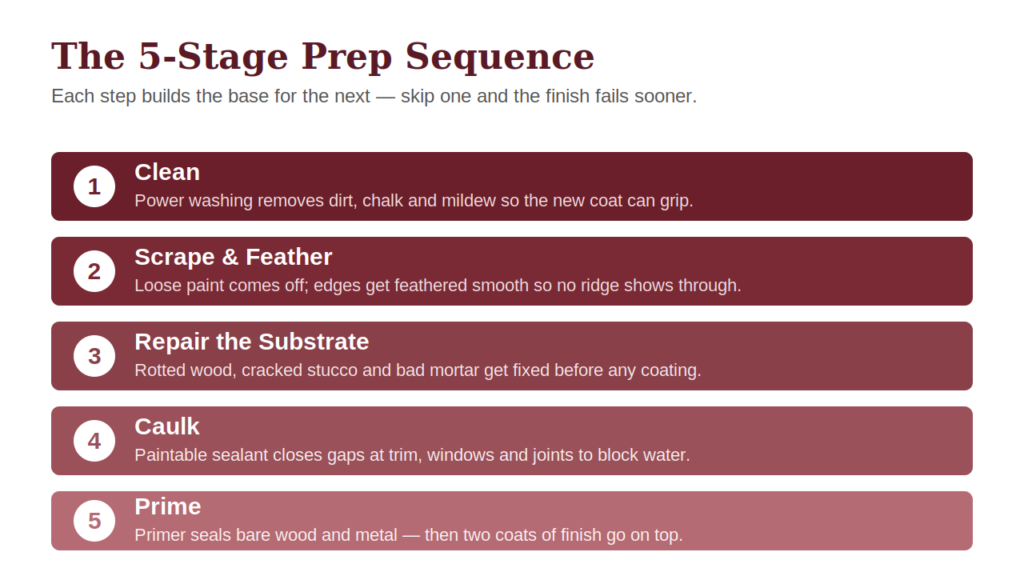
Surface preparation involves cleaning, scraping and feathering, substrate repair, caulking, and priming, performed in that order. Each step builds the base for the next, so skipping one weakens the whole system. Power washing opens the process; priming seals it before any topcoat.
People assume prep is one task. It is really five, and they have to happen in sequence. Do them out of order and you undo your own work. Here is how a full exterior runs at Fortune Restoration, and why each stage earns its spot. The diagram below shows the same sequence at a glance.
Cleaning the surface
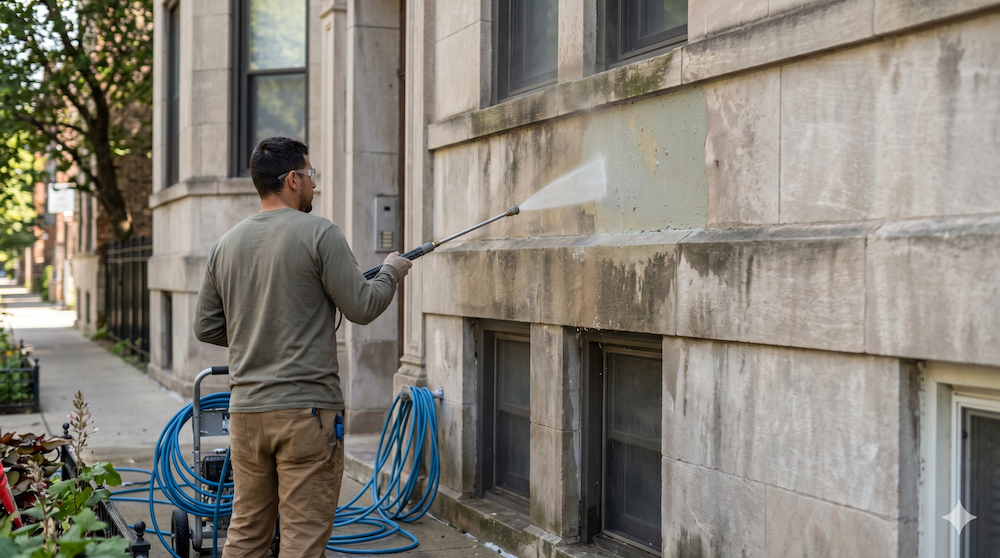
Everything begins with a wash. Power washing at the right pressure strips off dirt, chalking and biological growth so the surface can actually bond. Too much pressure damages soft brick or wood, so technique matters here. If you want to know where this tool helps and where it does not, read our take on what power washing can and can’t do.
Scraping and feathering
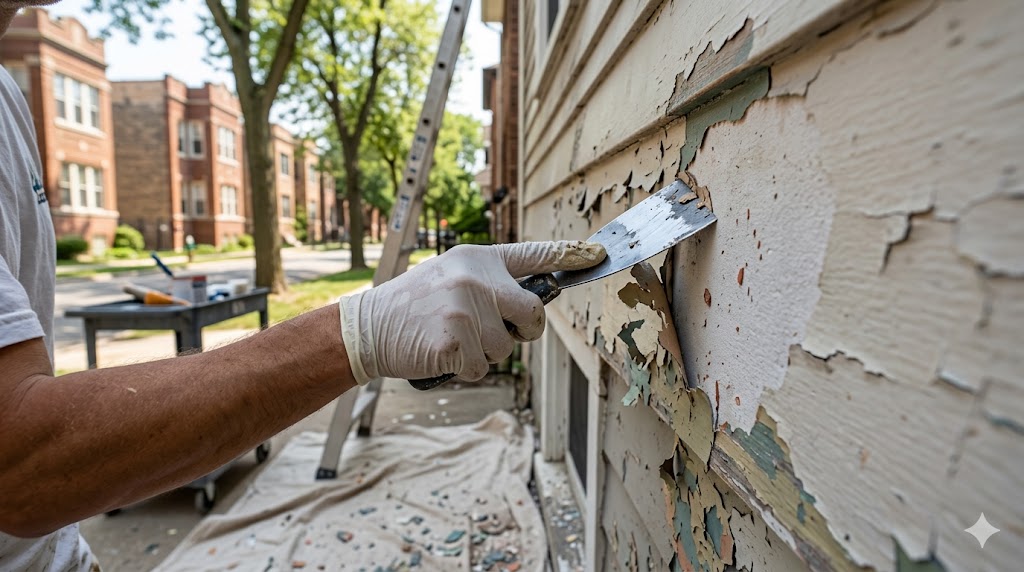
Next we scrape every loose, peeling or cracking spot back to a firm edge. Then comes feathering — sanding that hard edge until it blends, so it will not telegraph a visible line through the fresh coat. This step is slow and boring and gets skipped constantly. We don’t skip it.
Repairing the substrate
Damaged wood, cracked stucco or failing mortar all get fixed now, before paint. Painting over a bad substrate just traps the problem and guarantees a repeat. A little patching today saves a full redo later.
Caulking every gap
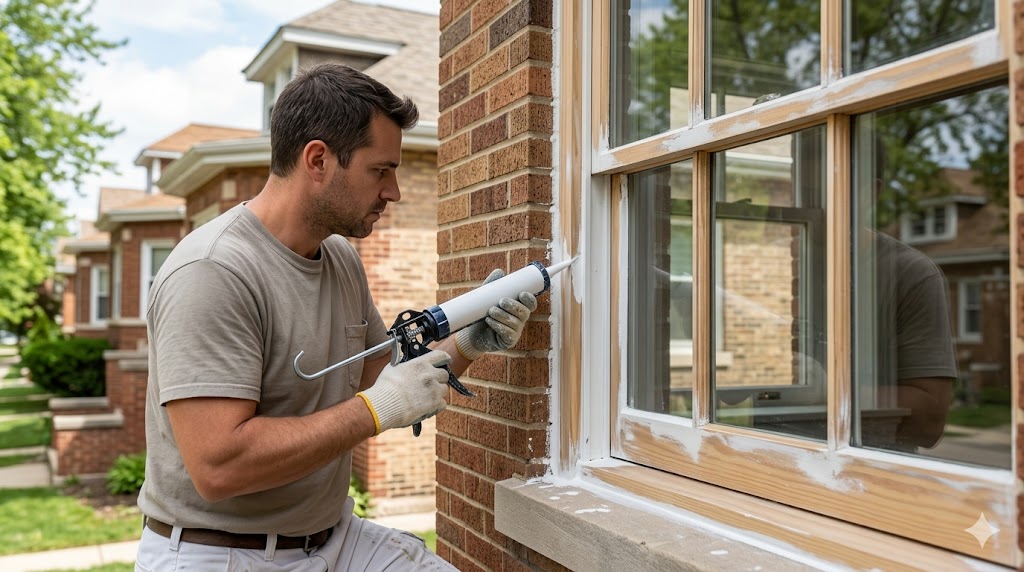
All the gaps around windows, doors and trim get a high-quality paintable sealant. Failed caulking is the number-one way water sneaks in on a Chicago home, so this is not the spot to go cheap.
Priming bare spots
Last, priming. Bare wood, bare metal and porous patches all need primer for adhesion and stain blocking. On detailed trim we even do back-priming so the hidden face is sealed too. The standards bodies that write the rules for surface preparation standards rank prep as the single biggest driver of coating life — which lines up with what we see in the field. Only after all of this do we apply a two-coat system, usually a quality acrylic latex with a built-in mildewcide.
Is masonry repair prep different from paint prep work?
Key Takeaways:
Masonry repair prep differs from paint prep work because masonry preparation focuses on mortar joints, water entry, and sound substrate rather than coatings. Sounding the surface finds hollow or spalling areas before repair. Repairs come first; sealing or coating comes last.
Yes — masonry plays by its own rules. With paint, you are getting a surface ready to hold a coating. With brick and stone, you are getting the wall itself ready to keep water out and stay sound. The order still matters, but the steps look different.
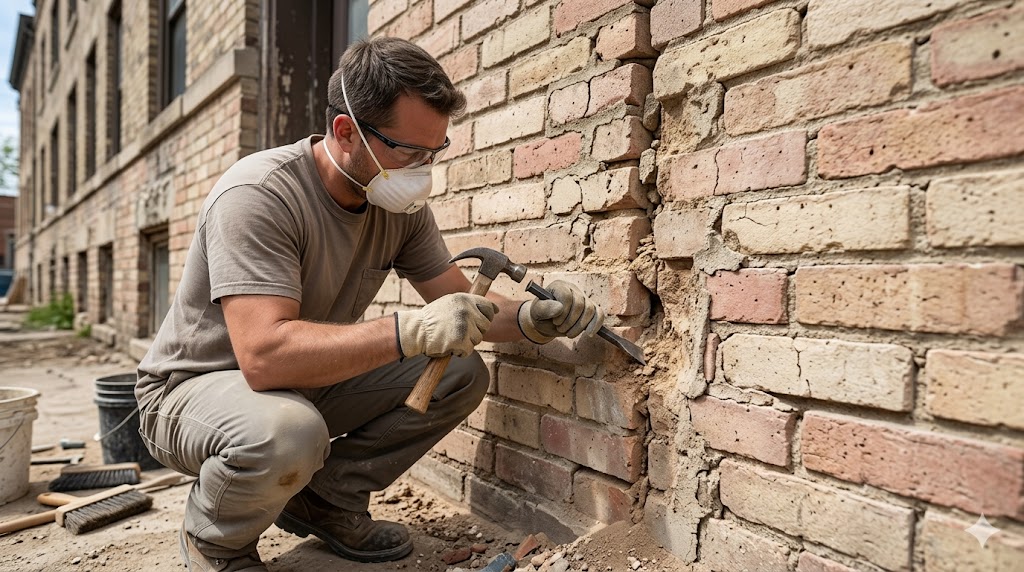
First we read the wall. A big part of that is sounding — tapping the masonry and listening for hollow spots that mean the face has come loose. We look for failing mortar joint lines, for spalling where the brick face is popping off, and for efflorescence, that chalky white salt that tells you water is moving through the wall. Efflorescence is a symptom, not the disease, so we chase the water, not just the stain.
Then repair comes before anything else. Tuckpointing bad joints, swapping spalled brick, fixing the leak path. Only after the wall is sound do we think about cleaning or a breathable sealer — and never a film coating that would trap moisture inside. You can see our full scope on the masonry repair service page. The principle is the same as paint though: fix first, finish last, every time.
How do you handle lead paint during prep on older Chicago homes?
Key Takeaways:
Lead paint on pre-1978 Chicago homes requires EPA RRP-certified crews using contained, lead-safe work practices during preparation. Testing comes before any scraping or sanding disturbs old coatings. Fortune Restoration holds RRP certification and follows lead-safe protocols on qualifying jobs.
This one we take dead serious. Any Chicago home built before 1978 may carry lead-based paint under newer layers, and the city has a lot of housing that old. The moment you scrape, sand or heat that paint, you can release lead dust. That is a health hazard, not a footnote.
The federal lead-based paint program requires certified contractors to follow contained, lead-safe work practices on pre-1978 housing. That means testing first, sealing off the area, capturing the debris and cleaning up to a verified standard — not just sweeping up and moving on. We do this work everyday across older Chicago neighborhoods, so the protocol is second nature for our crews.
Fortune Restoration carries EPA RRP / lead paint certification, and our field supervision holds the safety credentials to back it up. We would rather lose a fast bid than cut corners that put a family or our own people at risk. If your home predates 1978, just tell us — we will plan the prep around it.
What four decades of prep work taught our crews
We have been at this in Chicagoland since 1979. Over 40 years on ladders and scaffolds teaches you that the boring steps are the ones that save the client money. The flashy finish gets the compliments, but the prep is what is still holding strong a decade later.
Our portfolio is not just bungalows and two-flats, either. We have done the kind of work that does not forgive shortcuts:
- Frank Lloyd Wright homes in Oak Park — historic surfaces where matching materials and gentle prep protect irreplaceable fabric.
- The Grosse Point Lighthouse in Evanston — heavy weather exposure that punishes any weak spot in the prep.
- The birthplace of Walt Disney — a landmark where careful, contained preparation came before a single brush stroke.
- Churches and greystones across the North Shore — big masonry envelopes where water control starts with sound joints.
That experience is also why our crews follow the lead-safe construction practices the federal safety agency lays out — on top of being licensed, bonded and insured. Forty years buys you a lot of lessons. The biggest one is simple: do the prep right, or do the job twice.
What should you look for in a Chicago painting contractor’s prep plan?
Key Takeaways:
A Chicago painting contractor’s prep plan should spell out cleaning, repair, caulking, and priming before any topcoat is quoted. Vague answers about preparation usually signal corners about to be cut. Bonded, insured, and RRP-certified credentials confirm the contractor takes preparation seriously.
Before you sign anything, make the contractor talk about prep — in detail. A crew that does thorough groundwork is proud of it and will happily explain every step. A crew that plans to rush will get vague fast, or pivot to bragging about the paint brand instead. That pivot is your warning sign.
You do not need to be an expert to test them. You just need a couple things on your list and the nerve to ask. Here is what we tell friends and family to ask any local painting contractor before hiring:
- How will you handle the existing peeling paint — will you scrape and feather all the edges?
- What is your caulking process, and which sealant do you use?
- Where will you prime, and with what kind of primer?
- Do you repair rotted wood, bad stucco and damaged mortar yourself, or sub it out?
- Are you licensed, bonded, insured and RRP-certified for older homes?
If the answers are clear and confident, that is a good sign. You can also see exactly how we approach this on our paint preparation service page. The right contractor treats your questions as a chance to show off the part of the job they care about most.
The real cost of skipping surface preparation
Let me put it in dollars, because that is what lands. A cheap bid usually means less coats and rushed prep — and it feels like a win until the second winter. When that paint peels early, you are not just paying to repaint. You are paying to strip the failed coat, fix the water damage that crept in behind it, and start the prep over from zero.
On most quality exterior jobs, the preparation eats up more labor hours than the actual painting does. That is not waste — that is the part you are really buying. A finish backed by real groundwork should give you 8 to 12 years in Chicago. A finish slapped over chalk and peel might give you three.
- 1979Family-run in Chicagoland since
- 8–12 yrsTypical exterior life with proper prep
- Pre-1978Homes likely to contain lead paint
- 2 coatsOur minimum on exterior surfaces
So the math is not really close. Spend a little more on prep once, or spend a lot more redoing a failed job and repairing the damage underneath it. Every dollar that goes into surface preparation is buying you years on the back end. That is the trade we have watched play out on thousands of Chicago homes.
Frequently asked questions about paint and surface preparation
How long should a properly prepped exterior paint job last in Chicago?
A properly prepped exterior should hold 8 to 12 years on most Chicago elevations. South- and west-facing walls take the most sun and may wear sooner. The single biggest factor is the surface preparation underneath the coating, not the price of the paint. Sound prep plus a two-coat acrylic latex system is what buys those extra years.
Can you skip primer if the old paint looks fine?
You should not skip primer on bare wood, bare metal, or any repaired or porous spot, even when nearby paint looks sound. Primer creates adhesion and blocks stains so the topcoat bonds and stays even. On detailed trim we also back-prime the hidden faces. Priming where it is needed is cheap insurance against early peeling.
What is feathering, and why does it matter?
Feathering is sanding the edge between old paint and bare substrate until the transition is smooth and flat. It matters because an un-feathered edge leaves a visible ridge that shows through the new finish. Feathering takes time, which is why rushed crews skip it. The result is the difference between a smooth wall and one with obvious paint lines.
Do you really need two coats of exterior paint?
Yes — two coats is the minimum for Chicago conditions, not an upsell. One coat rarely hides the surface evenly or builds enough film to handle freeze-thaw and UV exposure. A proper two-coat acrylic latex system gives the durability and color depth a single coat cannot. Bids offering one coat are usually cutting cost in the wrong place.
How do I know if my Chicago home has lead paint?
Assume lead is possible on any Chicago home built before 1978 until a test confirms otherwise. Certified testing during the estimate stage settles the question before any scraping or sanding begins. If lead is present, an RRP-certified crew uses contained, lead-safe work practices to control the dust. Fortune Restoration handles testing and lead-safe prep on qualifying homes.
Is power washing enough to prepare a surface for paint?
No — power washing is the first prep step, not the whole job. Washing removes dirt, chalk and mildew so coatings can bond, but it does not scrape loose paint, repair substrate, caulk gaps, or prime. Treating a wash as full preparation leads to early failure. Cleaning sets up the four steps that follow it.
What is the difference between caulk and sealant in paint prep?
In practice both fill gaps, but a paintable sealant flexes more and holds up better at joints that move. Caulking around trim, windows and dissimilar materials blocks the moisture intrusion that causes most exterior failures. The product has to stay flexible through Chicago’s temperature swings. Using a quality paintable sealant is standard on every Fortune Restoration prep job.
Start with a free Chicago estimate
Tell us about your home and we will build a prep-first plan that lasts. Request an estimate from Fortune Restoration, or call us at 847-647-2500.