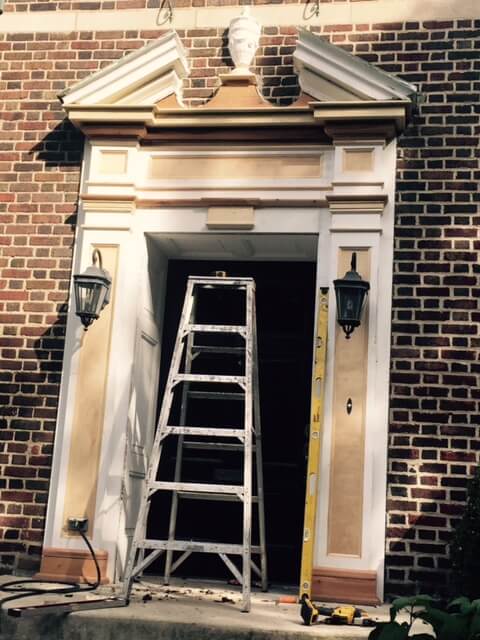

Fortune Restoration provides professional door replacement and eaves repair across Chicago and the North Shore - front entry doors, patio doors, custom and historic doors, plus matching fascia, soffit, and overhang carpentry. Family-owned since 1979.
The front door is the first thing anyone notices about a building. A worn, drafty, or dated door drags down curb appeal, leaks heat all winter, and tells visitors the rest of the house is probably the same. The right replacement does the opposite - it lifts the whole exterior, cuts heating costs, and lasts decades when it’s installed correctly.
I’m Peter Fortune. We’ve been replacing exterior doors, restoring historic doors, and rebuilding eaves and soffits across Chicago and the suburbs since 1979. From standard prehung steel doors on a Logan Square two-flat to custom millwork doors on a Frank Lloyd Wright home in Oak Park, the work covers everything in between. Request a free estimate to discuss your project.
Door Replacement Services
We replace exterior front doors, side and rear entry doors, patio doors, French doors, sliding doors, and custom and historic doors on residential, commercial, and multi-unit buildings across Chicagoland.
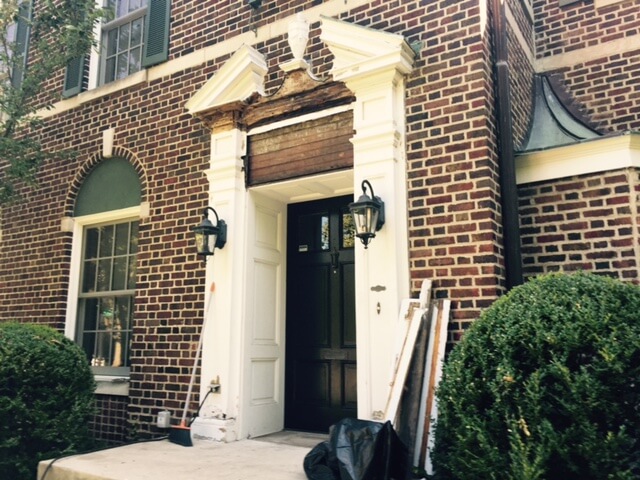
Door replacement isn’t just swapping out the door slab. A proper replacement involves removing the existing unit, inspecting and repairing the rough opening if needed, installing the new prehung or custom door square and plumb, weatherstripping, finishing the trim, caulking the perimeter, and integrating the threshold properly with the floor and exterior cladding. Skip any of those steps and the door looks fine for a year, then starts sticking, drafting, or leaking.
Our scope covers everything from single-door replacements on a single-family home to multi-unit door programs for property management firms cycling through dozens of identical doors across a portfolio. See our broader carpentry services and our property management work.
Best Door Materials for Chicago’s Climate
The four main exterior door materials are wood, fiberglass, steel, and composite. Each has tradeoffs in cost, insulation value, durability, and appearance - and Chicago’s freeze-thaw climate punishes the wrong choice.
Wood Doors
Real wood doors - solid hardwood or stave-core construction - are the traditional choice and remain the only authentic option for historic homes. They’re beautiful, they take stain and paint well, and they age handsomely. The tradeoffs are cost, weight, and maintenance: wood doors need refinishing every few years on exposed exposures, and they swell and contract with humidity. On covered porches and entries with overhead protection, wood is excellent. On full-sun south or west exposures with no overhang, wood is a maintenance commitment.
Fiberglass Doors
Fiberglass entry doors have become the standard mid-to-premium choice for Chicago homes. They’re stable through freeze-thaw cycling, won’t warp or rot, take paint and stain well (some lines convincingly mimic wood grain), and offer R-values of 5 to 6 - significantly better than wood or steel. The downside is appearance: even premium fiberglass falls short of real wood on close inspection, and on high-end historic homes that gap can be jarring.
Steel Doors
Steel doors are the most economical option and the most secure. They’re filled with foam insulation that gives them solid R-values around 5 to 7, and they don’t warp, rot, or rack out of square. The downsides are appearance (steel doors look like steel doors), denting (a thrown shovel will leave a permanent mark), and rust on older or damaged units. Standard choice for utility doors, side doors, and budget-conscious primary entries.
Composite and Vinyl Doors
Composite doors blend materials - typically fiberglass skins over a wood or steel frame with foam core insulation. Vinyl is occasionally used for patio sliders. Both are durable in Chicago’s climate. Composite is a strong choice for patio and French doors where dimensional stability matters more than visual authenticity.
The Energy Star guidance on doors and windows covers performance specifications by climate zone - Chicago is in Climate Zone 5, which calls for U-factors of 0.30 or lower for maximum thermal performance. The National Fenestration Rating Council (NFRC) provides standardized ratings on every certified door so you can compare apples to apples.
Front Door, Patio Door, and Specialty Door Replacement
We replace every type of exterior residential and light commercial door - single entries, double entries, patio sliders, French doors, Dutch doors, side and rear utility doors, basement walk-out doors, and storefront-style doors on commercial buildings.
Different door types have different installation considerations:
- Front entry doors - typically prehung in a factory frame. Critical interface points are the threshold, the brickmould or trim, and the weatherstrip seal at all four edges.
- Patio sliding doors - large rough openings that need careful header support, proper flashing under and around the unit, and precise leveling for smooth operation. A patio door installed slightly out of square will bind for the rest of its life.
- French doors - paired hinged doors that meet at an astragal in the center. The astragal seal and the alignment of both door slabs are the hard parts.
- Custom-sized doors - vintage Chicago homes often have door openings that don’t match modern standard sizes. Either the opening gets modified to accept a standard prehung, or a custom door is fabricated to fit the existing opening. We do both.
- Specialty hardware - multipoint locks, smart locks, mortise lock sets, period-correct hardware on historic homes. Hardware compatibility affects door selection.
Custom and Historic Door Restoration
For historic Chicago homes - Victorian Painted Ladies, Prairie-style homes, Arts and Crafts bungalows, vintage greystones - original doors are often worth restoring rather than replacing. Where replacement is necessary, custom door fabrication preserves architectural integrity.
Original Chicago doors from the 1890s through the 1930s were often built with quarter-sawn oak, mahogany, or fir, with detail and craftsmanship that’s expensive to reproduce. When the door is structurally sound but has been painted over, weathered, or had hardware swapped out, restoration through our wood stripping and refinishing service is often the right call.
When the door is too far gone or was already replaced with an inappropriate substitute, our custom millwork service can reproduce the original. We’ve worked on doors at landmark properties including Frank Lloyd Wright homes, the Grosse Point Lighthouse in Evanston, and dozens of historic Chicago homes. For projects on landmark properties, replacement door specifications may require Commission on Chicago Landmarks approval - we navigate that process regularly.
Eaves, Soffit, and Fascia Replacement
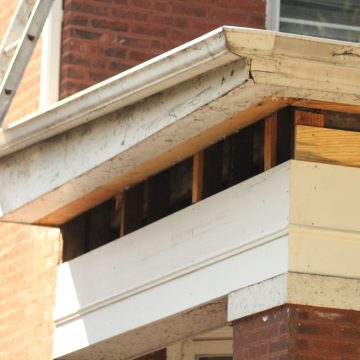
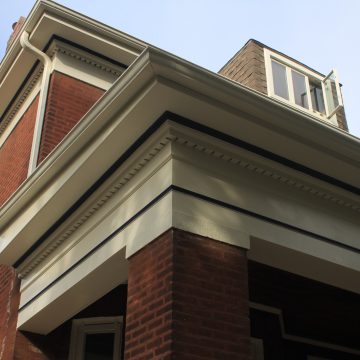
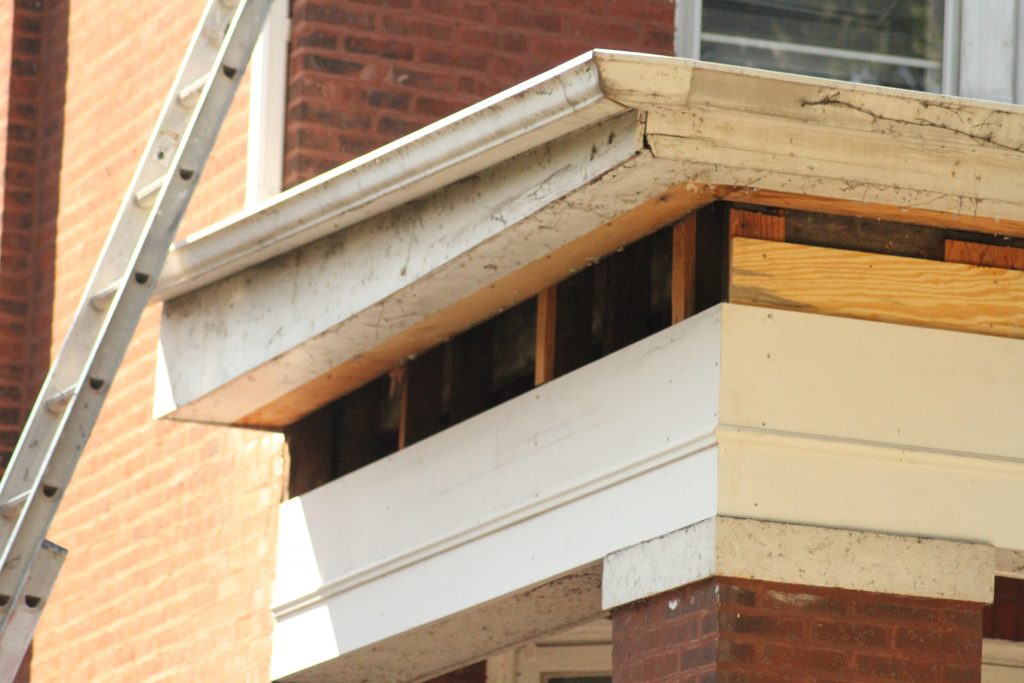
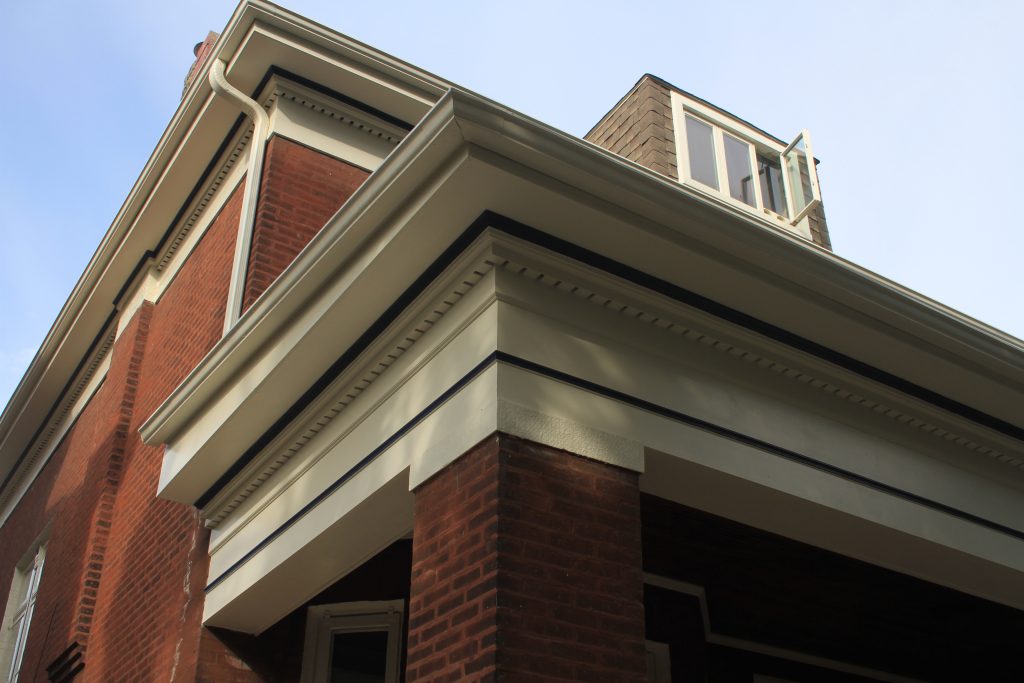
Eaves are the underside of the roof overhang. Soffit is the horizontal panel that closes off the eaves from below. Fascia is the vertical board at the end of the rafters where the gutter mounts. All three rot in Chicago’s climate when water gets behind them.
Eaves work is closely related to door, window, and exterior carpentry - same trades, similar materials, often the same project. We see eaves problems develop the same way most exterior wood failures develop: water gets in through a paint failure, a missing flashing, a clogged gutter that overflows behind the fascia, or an animal entry point. Once the wood is wet, freeze-thaw and biological decay take over.
Common signs your eaves and fascia need attention:
- Visible peeling paint or stained wood on the underside of the overhang
- Soft or spongy wood when probed with a screwdriver
- Soffit panels sagging, separating, or showing daylight gaps
- Gutters pulling away from the fascia board
- Animal or insect entry - birds, bats, squirrels, wasps nesting in the eaves
- Water staining on the exterior wall directly below the eave line
Eaves replacement typically involves removing the existing fascia and soffit, inspecting and repairing the rafter tails and roof structure if needed, installing new pressure-treated or PVC fascia and soffit material, ventilating properly to prevent ice damming, and finishing the work to match adjacent exterior trim. Often this happens as part of a broader exterior project - see our related work in siding replacement and repair, custom millwork, and porch and deck restoration.
Related Carpentry and Exterior Services
Door and eaves work often coordinates with other exterior services on the same project:
- Window replacement - frequently scheduled together with door work for whole-elevation refresh
- Shutter replacement and repair - completes the front-elevation appearance
- Glass replacement - for transom and sidelight repairs around door units
- Column restoration - porch and entry column work that pairs with door replacement on Victorian and Craftsman homes
- Exterior painting - finishing the new door, trim, and any adjacent siding or millwork
Service Area
Fortune Restoration provides door and eaves replacement across Chicago and the surrounding suburbs, with regular work in Evanston, Wilmette, Winnetka, Highland Park, Lake Forest, Oak Park, Hinsdale, Park Ridge, La Grange, and most other communities within roughly 30 miles of our Lincolnwood office.
Within Chicago city limits we work across virtually every neighborhood, including Bucktown, Lincoln Park, Lakeview, Logan Square, Wicker Park, Old Irving Park, Sauganash, Edgewater, Andersonville, Roscoe Village, Lincoln Square, Norwood Park, Beverly, Hyde Park, Gold Coast, and the Loop.
Why Choose Fortune Restoration for Door Replacement
- Family-owned and operated since 1979 - over 45 years of Chicago carpentry experience
- Master carpenters on staff with custom millwork capability for non-standard doors
- Licensed, bonded, and insured
- EPA Lead-Safe (RRP) Certified for pre-1978 buildings (relevant on most historic Chicago homes)
- Documented experience on Chicago Landmark and National Register historic properties
- Single contractor for door, window, eaves, exterior painting, and adjacent carpentry - no subcontractor handoffs
- Free written estimates with material recommendations matched to the building’s age and exposure
- Coordination with exterior painting and trim work to deliver a finished result, not just a swapped door
Ready to replace a door, restore an original, or address rotting eaves? Request a free estimate, contact us, or call 847-647-2500.
Frequently Asked Questions About Door & Eaves Replacement
How much does it cost to replace an exterior door in Chicago?
Standard prehung exterior door replacement in Chicago typically runs $1,200 to $3,500 installed for steel or fiberglass units. Premium fiberglass and solid wood doors range from $3,000 to $8,000+. Custom-fabricated doors for historic homes can run $5,000 to $15,000 depending on size, materials, and detail.
Patio sliders and French doors price separately based on opening size, glass package, and hardware. We provide free, detailed estimates so you know what’s involved before any work starts.
How long does door replacement take?
A standard prehung exterior door replacement takes one day for the install, including removing the old door, prepping the opening, setting and shimming the new unit, weatherstripping, caulking, and finishing the interior trim. Painting or staining the door adds another day or two depending on conditions.
Custom doors take longer - often 4 to 8 weeks for fabrication before installation can be scheduled. Eaves and fascia work typically runs one to three days depending on the linear footage and condition of the underlying structure.
What’s the best door material for Chicago’s climate?
Fiberglass is the best all-around choice for Chicago’s freeze-thaw climate. It’s dimensionally stable, won’t rot or warp, offers strong insulation values around R-5 to R-6, and takes paint and stain well. Solid wood is the right choice for historic homes where authenticity matters.
Steel is the most economical and secure option, ideal for utility and side doors. Avoid hollow-core or low-grade prehung units on exterior applications - they fail quickly in Chicago weather regardless of material.
Should I repair or replace my front door?
Repair makes sense when the door is structurally sound, made of quality material (especially solid wood on historic homes), and has cosmetic or hardware issues. Replace when the door is rotted, warped, damaged beyond repair, drastically out of style, or so drafty that energy loss exceeds the replacement cost over a few years.
For historic homes, default to repair and refinishing - original doors are often higher quality than anything available today. For postwar homes with low-grade original doors, replacement is usually the better long-term move.
Do you replace doors on historic homes?
Yes. Historic door work is one of our specialties. We restore original doors when they’re salvageable, fabricate custom replacements through our millwork shop when they aren’t, and navigate the Commission on Chicago Landmarks approval process when required.
We’ve worked on doors at landmark properties including Frank Lloyd Wright homes, the Grosse Point Lighthouse, and dozens of historic Chicago homes. See our historical landmark portfolio.
Can you match a custom or specialty door size?
Yes. Vintage Chicago homes often have door openings that don’t match modern standard sizes. Through our custom millwork capability, we fabricate doors to exact dimensions, match historic profiles and panel layouts, and reproduce period-correct details.
The alternative is modifying the existing opening to accept a standard prehung unit - sometimes the right call, sometimes not. We help homeowners weigh both options based on the building’s architecture and the project budget.
Do you handle eaves, soffit, and fascia work too?
Yes. Eaves, soffit, and fascia replacement is part of our exterior carpentry work, and it’s often scheduled alongside door replacement, window replacement, or exterior painting when the underlying carpentry needs attention.
Common eaves problems we address include rotted fascia behind failing gutters, sagging soffit panels, animal damage, and ventilation issues that contribute to ice damming. We replace failing material with pressure-treated wood, PVC, or composite depending on the application and the building’s character.