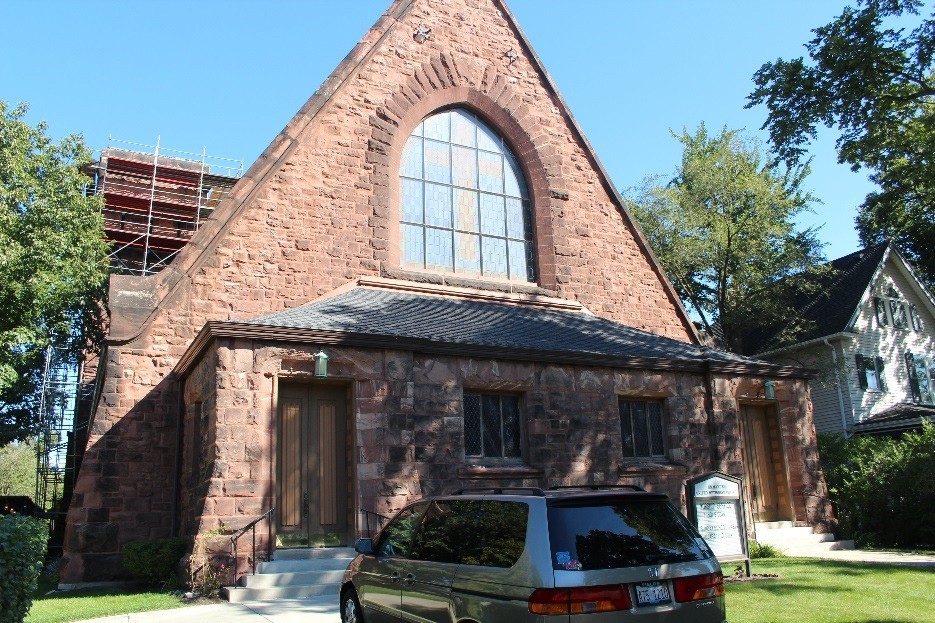
What Does Church Restoration in Chicago Actually Include?
Key Takeaways:
Church restoration includes exterior masonry repair, interior and exterior painting, plaster repair, decorative finish work, and carpentry. Most projects begin with a full building assessment. Exterior water problems must be corrected before interior finishes are touched.
People hear “church restoration” and picture fresh paint in the sanctuary. That’s usually the last step, not the first. A complete church restoration program covers the whole building envelope and everything inside it:
Exterior masonry. Tuckpointing failed mortar joints, replacing spalled brick, repairing stone, resetting coping, and stabilizing parapets and towers. On Chicago’s older religious buildings, this is almost always where the real trouble lives.
Exterior painting and carpentry. Wood trim, doors, eaves, soffits, columns, and window frames take a beating in our climate. Rotted wood gets repaired or replicated before any paint goes on.
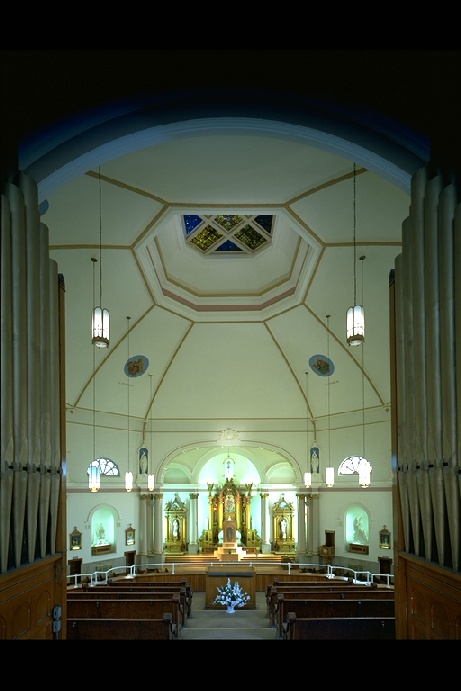
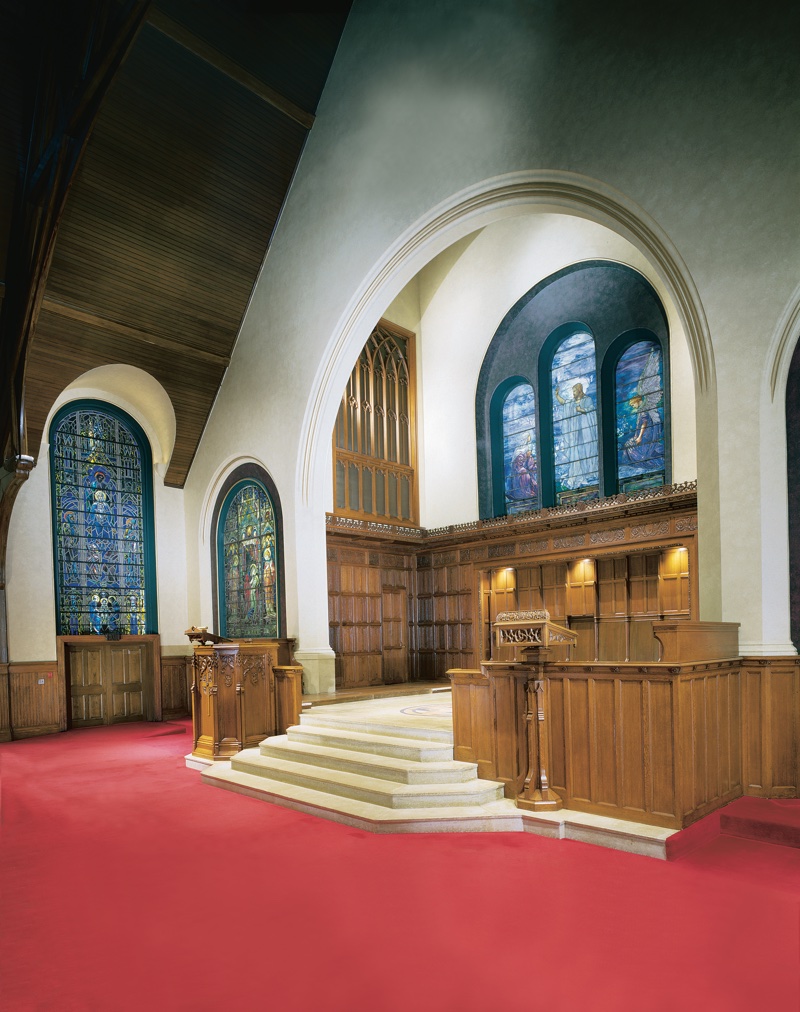
Interior plaster and paint. Sanctuary walls, vaulted ceilings, domes, and naves — usually plaster over lath or masonry — need crack repair, patching, and sometimes full re-plastering before priming and painting.
Decorative finishes. Stenciling, gilding, faux finishes, murals, and polychrome detail. This is specialty work, and it’s what separates a church painting contractor from a residential painter.
The order matters more than the amount of individual trades involved. Water comes from outside. If the steeple, parapet, or mortar joints are leaking, a beautiful new interior paint job will stain and peel within a couple seasons. Fix the envelope first. Always. You can see the range of this work across our church painting and restoration portfolio, which spans Catholic, Protestant, and nondenominational buildings across Chicagoland.
How Much Does It Cost to Paint or Restore a Church?
Key Takeaways:
Church interior painting in Chicago typically runs $30,000 to $150,000 or more, driven by ceiling height, scaffolding, and decorative detail. Small chapels cost less; basilicas cost more. Exterior masonry restoration is priced separately after a hands-on inspection.
This is the first question every building committee asks, so let me answer it honestly instead of dodging it. Cost on church work is driven by three things: access, surface condition, and decorative complexity.
A modest chapel with 14-foot flat ceilings and sound plaster might be repainted for what a large house costs. A full sanctuary repaint in a building with 40-foot vaulted ceilings, plaster repair, and stencil restoration is a different animal — in our experience, those projects commonly land between $30,000 and $150,000, and major basilica interiors can go well beyond that. Scaffolding alone can be a meaningful share of the budget, because a safe working platform under a dome takes days to erect before a brush ever touches the wall.
Exterior masonry is harder to ballpark from the street. Tuckpointing is priced by the extent of failed joints, the height of the work, and whether brick or stone needs replacement — and on towers and steeples, access equipment drives cost the same way interior scaffold does. Nobody can give your congregation a real number without sounding the walls and getting up close. Be suspicious of anyone who quotes a church from the sidewalk.
Planning a restoration budget for your congregation? Request a free estimate from Fortune Restoration and get real numbers your committee can plan around.
Planning a Church Restoration Project
After four decades of this work, I’ve watched well-run projects and painful ones, and the difference is almost never the contractor’s skill. It’s the planning. Here’s the roadmap I’d hand any building committee on day one.
Assess the Building First
Before anyone votes on anything, get a top-to-bottom condition assessment: roof, steeple, parapets, masonry, flashing, windows, plaster, paint. Photograph everything. This document becomes the basis for scope, budget, fundraising materials, and the order of work. It also stops the most common planning mistake — spending the whole budget on the visible interior while the parapet quietly destroys it from above.
Set Scope and Phases
Very few congregations can fund everything at once, and that’s fine. A phased program — envelope repairs year one, exterior paint year two, interior restoration year three — protects the building in the right order and spreads cost across budget cycles. Each phase should leave the building stable and watertight on its own.
Sequence Exterior Before Interior
I’ve said it once already but it’s the rule that saves congregations the most money, so it bears repeating: masonry and roofing repairs come before interior finishes. For landmark-designated churches, build permit time into the schedule too — exterior work on designated buildings goes through the Commission on Chicago Landmarks permit review process before it can start.
What Causes Water Damage in Old Church Buildings?
Key Takeaways:
Water damage in old church buildings starts at steeples, parapets, coping stones, flashing, and failed mortar joints. Gravity carries water down through walls into plaster and finishes. Interior stains almost always trace back to exterior masonry failures.
Churches are tall, exposed, and full of complicated rooflines — which makes them water magnets. When a committee shows me a stained sanctuary ceiling, the cause is nearly always above and outside.
Steeples and Towers
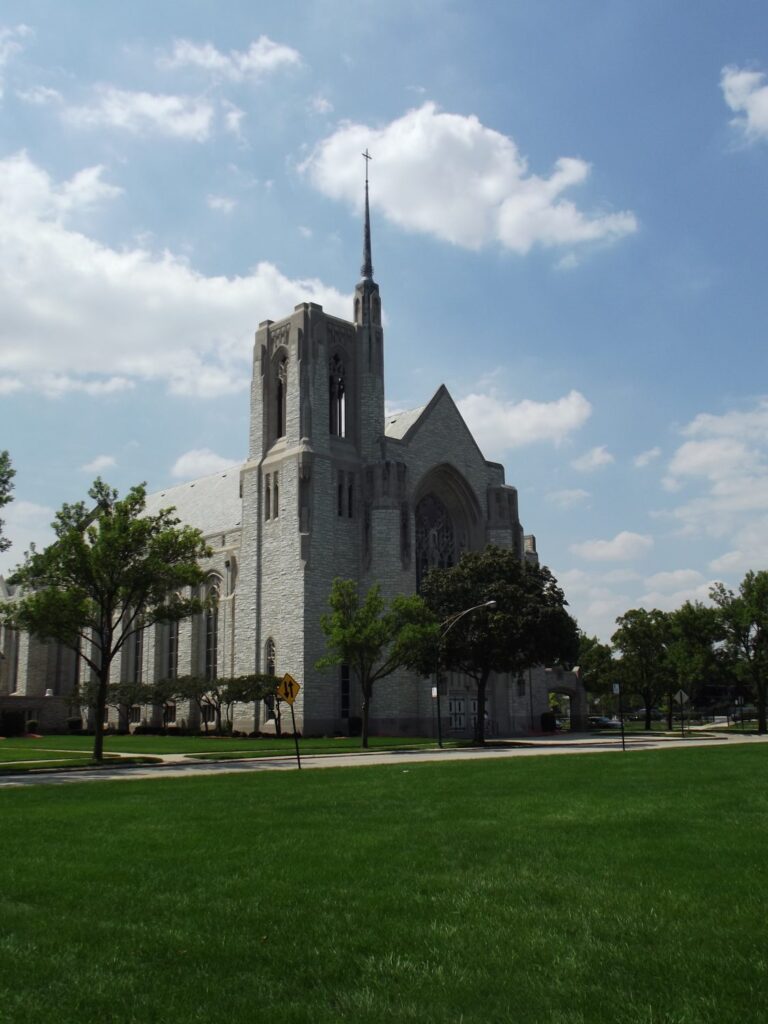
A steeple is the most weather-exposed structure on the block. Wind-driven rain hits it from every side, freeze-thaw cycling works on every joint, and most haven’t been inspected up close in decades. Failed flashing and open mortar joints at the tower send water straight down through the building — the stain shows up two floors below where the water got in.
Parapets and Coping
Flat-roofed parish halls, schools, and additions all have parapet walls capped with coping stones. When the coping joints open up, water pours into the top of the wall, it just keeps working downward until somebody stops it. Chronically wet parapets lose their mortar, lean, and eventually become a safety problem the City of Chicago will cite.
Failed Mortar Joints
Mortar is sacrificial by design — it’s meant to deteriorate so the brick doesn’t. On a 100-year-old church, joints that have never been repointed are past due. We covered the mechanics of this in our deep dive on tuckpointing, and everything in it applies double to churches, where wall heights and exposure are greater. One related caution: stained glass window surrounds are a frequent leak point, and aggressive repairs can damage irreplaceable glass. The National Park Service’s preservation brief on stained and leaded glass is required reading before anyone touches those openings.
Seen stains on the sanctuary ceiling or white deposits on the brick? Request a free assessment and estimate before a small leak becomes a big repair.
How Do You Paint a Church Ceiling?
Key Takeaways:
Church ceilings are painted from full interior scaffolding or lift equipment, never ladders. Crews protect pews and floors, repair plaster, then prime and paint in sections. Stenciling, gilding, and murals require specialty decorative finishers.
This question comes up constantly, because almost nobody who paints houses for a living has ever stood on a scaffold deck 40 feet above a marble floor. Here’s how the work actually goes.
Interior Scaffolding Systems
Everything starts with safe access. For vaulted naves and domes, that means engineered frame scaffolding built up from the floor — with the pews, organ, altar, and flooring protected underneath it — or, where the structure allows, articulating lifts. Scaffold erection on a large sanctuary can take a week or more before any painting begins, and it has to comply with OSHA scaffolding standards the entire time. Our Field Superintendent, Dan Stojak, is OSHA certified and supervises scaffold work on every church project we run.
Plaster Repair and Priming
Once crews are up at ceiling level, the real condition of the plaster becomes visible — hairline cracking, delamination, old water damage. Repairs happen first, then the right primer for the substrate. Skipping straight to paint over chalky or damaged plaster is how a five-figure project fails in two years.
Decorative Painting and Gilding
Many Chicago sanctuaries carry stenciling, gold leaf, faux stone finishes, or painted medallions from the original construction. You can’t roll over that. These elements get documented, preserved, and restored by hand — the same care we bring to our historic landmark restoration work on buildings like the Grosse Point Lighthouse and the birthplace of Walt Disney.
Lead-Safe Work Practices
Nearly every church built before 1978 has lead-based paint somewhere in the layer history. Sanding, scraping, and plaster demolition disturb it. Fortune Restoration is EPA RRP certified, and we run containment, cleanup, and disposal to federal lead-safe standards on every pre-1978 building — non-negotiable when the people using the space include children in religious education programs.
Can a Church Stay Open During Restoration?
Key Takeaways:
Yes, most churches stay open during restoration. Work zones are contained, scaffolding is built and moved in sections, and crews schedule around services. Weddings, funerals, and holidays are planned into the project calendar from day one.
A congregation is not a tenant that can relocate for a season. Worship continues. So do weddings, funerals, baptisms, and the school calendar. The honest answer is yes — churches stay open through restoration all the time — but it only goes smoothly when the contractor plans for it instead of treating the congregation as an inconvenience.
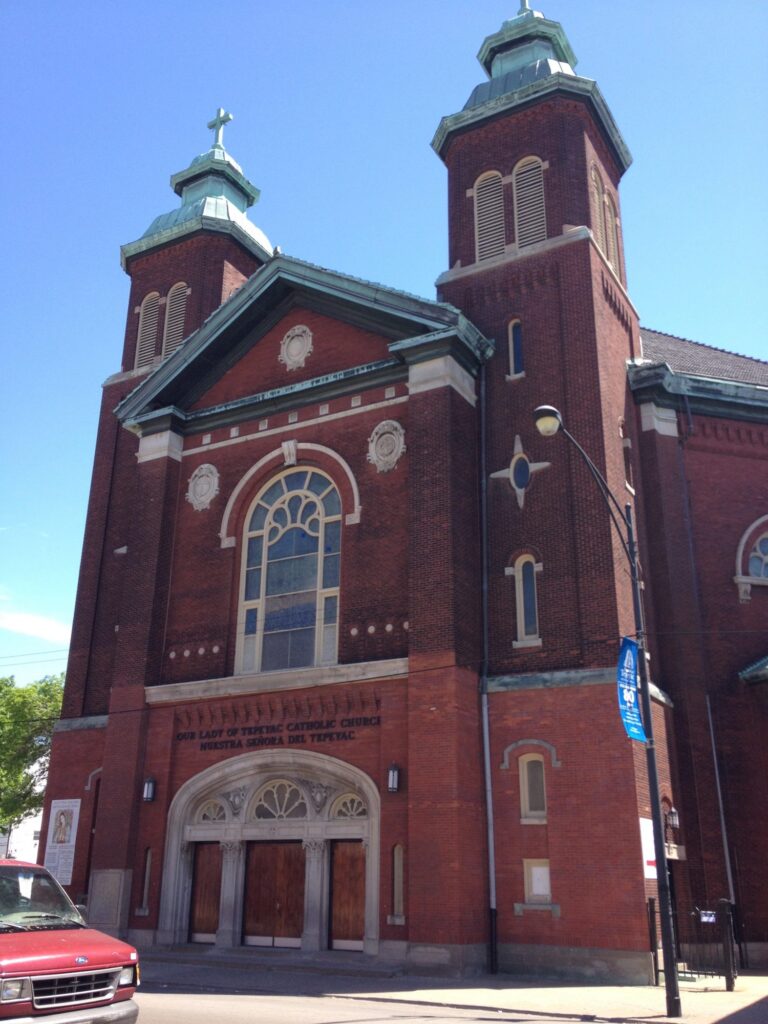
In practice that means sectioned scaffolding so part of the sanctuary stays usable, dust containment between work zones and occupied space, Friday cleanups so Sunday looks presentable, and a project calendar comprised of every fixed date the parish has on the books — Holy Week, Christmas, confirmations, the school year. Funerals are the one thing you can’t schedule, so the crew needs a same-day plan for clearing and quieting the space. We’ve worked through active parish life at churches like St. Mary of the Angels and Our Lady of Tepeyac, and that scheduling discipline is as much a part of the job as the painting is.
Worried about keeping services running during the work? Request an estimate and we’ll build a phasing plan around your congregation’s calendar.
How Do Churches Pay for Restoration Projects?
Key Takeaways:
Churches pay for restoration through capital campaigns, diocesan or denominational funds, preservation grants, and phased multi-year budgets. Matching grants exist for historic religious buildings. Phasing spreads cost across several budget years without leaving the building exposed.
Money is the part committees lose sleep over, so it deserves a straight section of its own. Most congregations fund restoration through some combination of four sources:
Capital campaigns. Still the backbone of most church projects. A good condition assessment with photos is your best fundraising tool — people give to fix a documented problem, not a vague one.
Diocesan and denominational support. Catholic parishes work through archdiocesan facilities offices and approval processes; many Protestant denominations maintain building loan funds and grant programs for member congregations.
Preservation grants. Historic religious buildings have a dedicated national funder: the National Fund for Sacred Places awards substantial matching grants, along with planning support, to congregations restoring historically significant buildings. Local preservation groups and community foundations add smaller pieces.
Phasing. Not a funding source exactly, but the tool that makes the others work. Breaking the program into watertight phases lets a parish raise and spend in steps instead of needing the whole number up front.
One practical note from our side of the table: contractors can help here. Clear scope documents, photographs, and phase-by-phase pricing give your campaign committee something concrete to put in front of donors and grant reviewers.
Why Chicagoland Congregations Trust Fortune Restoration
My family started this company in 1979, and church work has been part of it nearly from the beginning. More than 45 years later we’re still family-run, still based in Lincolnwood, and still doing the painting, masonry, plaster, and carpentry with our own crews instead of stacking subcontractors. We’re licensed, bonded, and insured. We’re EPA RRP certified for lead-safe work on older buildings. And Dan Stojak, our Field Superintendent, brings EPA RRP, lead-safe, and OSHA certifications to every scaffold we put up.
The portfolio tells the rest of the story: Queen of All Saints Basilica, St. Mary of the Angels, St. Gregory the Great, First Presbyterian of Lake Forest, Emmanuel United Methodist in Evanston, St. Mary in Aurora, Mercy Home for Boys & Girls downtown, and more. Different denominations, different architecture, same standard of care. If it helps your committee, we’re glad to share references from congregations who’ve been through the process — and if your project starts with the exterior, our guide to how Chicago weather destroys exterior paint explains why our climate sets the maintenance clock.
Ready to talk about your church, chapel, or parish building? Request a free estimate from Fortune Restoration — serving Chicago and the North Shore since 1979.
Frequently Asked Questions
Who restores historic churches in Chicago?
Fortune Restoration is a family-run Chicago contractor that has painted and restored churches since 1979, including Queen of All Saints Basilica, St. Mary of the Angels, and First Presbyterian of Lake Forest. The firm is licensed, bonded, insured, and EPA RRP certified, and its crews handle masonry, painting, plaster, and carpentry under one roof.
How long does church restoration take?
Most church restoration projects take two weeks to six months. A single-elevation tuckpointing job may finish in two to three weeks. A full interior repaint with scaffolding, plaster repair, and decorative finishes often runs eight to sixteen weeks. Phased multi-year programs are common for large buildings with limited budgets.
How often should a church building be repainted?
A church exterior in Chicago should be repainted about every 8 to 12 years; interiors often last 15 to 25 years because they avoid weather exposure. Buildings with heavy candle use, humidity swings, or roof leaks may need interior work sooner. Annual inspections catch problems before they force early repaints.
What is the difference between church restoration and renovation?
Restoration returns a church to its original appearance using compatible materials and historically accurate finishes. Renovation updates the building for modern use and may change layouts, materials, or finishes. Many projects combine both, restoring decorative painting and masonry while renovating lighting, accessibility, or mechanical systems.
Do historic churches need special restoration contractors?
Yes. Landmark and historically significant churches require contractors familiar with the Secretary of the Interior’s Standards, lime-based mortars, traditional plaster systems, and decorative finishes. Using modern materials that are too hard or too vapor-tight can permanently damage historic fabric. Ask for comparable church references before hiring.
What permits are needed for church restoration in Chicago?
Structural masonry repairs, scaffolding in the public way, and most exterior restoration work in Chicago require permits from the Department of Buildings. Designated Chicago Landmark churches also need approval from the Commission on Chicago Landmarks before exterior changes. A qualified contractor manages permit applications as part of the project.
Is lead paint a concern in old church buildings?
Yes. Almost every church built before 1978 has lead-based paint under newer coatings. Federal rules require EPA RRP certified contractors to contain, manage, and dispose of disturbed lead paint safely. Fortune Restoration is RRP certified, and Field Superintendent Dan Stojak holds EPA RRP, lead-safe, and OSHA credentials.