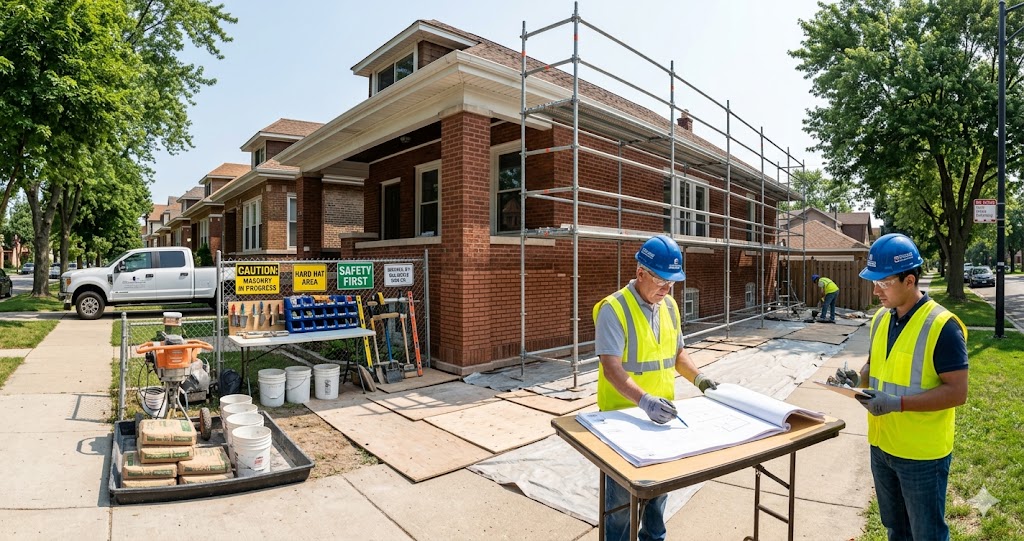
Hiring a masonry contractor in Chicago looks simple from the outside and turns out to be anything but. I’ve been running masonry crews here since 1979, and the gap between a great mason and a bad one shows up two winters after the job is done - when the work either holds, or starts falling apart in chunks.
This is the conversation I wish every Chicago property owner could have before signing a contract. Whether you are looking at brick repair, tuckpointing services, chimney work, or full facade restoration, the nine questions below will help you tell real masonry contractors from the folks who showed up with a trowel last spring.
Some are about credentials. Some are about process. A couple are about how the work gets done at street level. All matter - and the way a contractor answers them tells you more than any glossy website.
How Do I Choose a Masonry Contractor in Chicago?
Verify they are licensed, bonded, and insured. Check their years of Chicago masonry experience. Ask to see similar past projects. Confirm the mortar mix is right for your building’s age. Make sure they grind out joints, not smear over them. Find out who is actually doing the work. Read the warranty. Confirm they pull the permit. Get a written, itemized estimate. A real masonry contractor answers all nine without hesitating.
1. Are You Licensed, Bonded, and Insured?
This is the floor. Not the ceiling - the floor. If a masonry contractor can not show proof of insurance and a current Chicago contractor license, walk away. No second conversation is worth having.
In Chicago, masonry contractors are required to be licensed through the Department of Buildings, and any reputable shop carries general liability and workers compensation coverage. The City of Chicago Department of Buildings publishes its licensing rules online.
Here is why this matters in plain language: if an uninsured worker gets hurt on your property, you can be held responsible. If an unlicensed contractor pulls down a parapet wall and damages your neighbor’s roof, your homeowner’s policy may not cover it. A licensed and bonded masonry contractor protects you. An unlicensed one transfers the risk to you. Masonry safety standards exist for a reason.
Ask for the certificate of insurance and the license number. Verify both - it takes ten minutes. At Fortune Restoration, we hand over that paperwork before the estimate is signed. We have been licensed, bonded, and insured for over four decades.
2. How Long Have You Been Doing Masonry Work in Chicago?
Years in the trade is not the same as years on a business card. First, ask how long the company has been in business. Then ask how long the people doing the work have been pointing brick.
Chicago’s housing stock is unusual. The brick on a 1905 greystone is different than the brick on a 1965 mid-century four-flat, and the mortar formulas behind both are different from anything you would mix on a job site today. Lime mortar vs cement mortar is not trivia - it is the difference between repairs that breathe and last, and repairs that trap moisture and spall the brick face within five years.
Fortune Restoration was founded in 1979. That is more than forty years on Chicago historic building masonry - brick, limestone, terra cotta, and stone - through more freeze-thaw cycles than most contractors see in a career. Our work has included Chicago landmarks like Frank Lloyd Wright homes in Oak Park, the Grosse Point Lighthouse in Evanston, and the birthplace of Walt Disney. See our historic landmark portfolio. Landmark masonry requirements are a specialty, not an add-on.
Experience also means we have seen what fails. We know which mortar mixes hold up on north-facing walls and which do not. We know improper tuckpointing signs when we see them - and how to undo them when somebody else got there first.
3. Can I See Past Projects Similar to Mine?
A good masonry contractor will not just say yes. They will be excited to show you. Photos before and after. Addresses you can drive past. Owners or property managers you can call. If somebody hesitates here, that tells you something.
What you want to see is similar work. If you own a single-family home masonry repair situation on a 1920s bungalow, you do not want photos of a brand-new strip mall. If you manage an HOA and need apartment building tuckpointing or commercial facade repair, ask to see multi-unit building masonry services and property management masonry services. HOA masonry maintenance is its own discipline. Pattern-matching to your building type matters more than generic “we have done a lot of work” claims.
Customer reviews masonry contractors collect online tell another part of the story. Read the bad ones especially - how the contractor responded is more telling than the five-star average.
Ready to talk to a Chicago masonry contractor who can show you the work? Request an estimate from us and we will walk you through projects in your neighborhood and on buildings like yours.
4. What Mortar Will You Use, and Why That One?
This is the question that separates the trades from the truck-and-trowel crowd. The right answer tells you the contractor understands the building. The wrong answer - or no answer at all - tells you everything.
Mortar is not one product. It is a family of formulas: Type N, Type O, Type S, lime-based, and various blends. The right mix depends on the age of the brick, the original mortar composition, the exposure (north and west walls take the worst of Chicago’s weather), and whether the wall is structural or veneer. Brick veneer vs solid brick changes the load path and moisture behavior of the assembly.
For pre-1930 Chicago buildings, the mortar is almost always softer and lime-rich. Using modern Portland cement mortar on a historic wall is one of the most common - and most expensive - mistakes I see. The new mortar is harder than the brick, so when the wall moves with temperature, the brick face cracks instead of the joint. You just traded a $4,000 tuckpointing job for $20,000 in brick replacement.
The National Park Service publishes a detailed preservation brief on repointing historic masonry that any serious masonry contractor should know cold. The answer tells you whether they treat historic brick preservation as a real specialty or a marketing line. Matching historic mortar and matching mortar color are part of the job.
The same logic applies to clay brick repair, limestone masonry repair, and natural stone restoration - each has its own compatible materials, and getting the substrate right is half the work.
5. Will You Grind the Joints Out, or Just Smear New Mortar on Top?
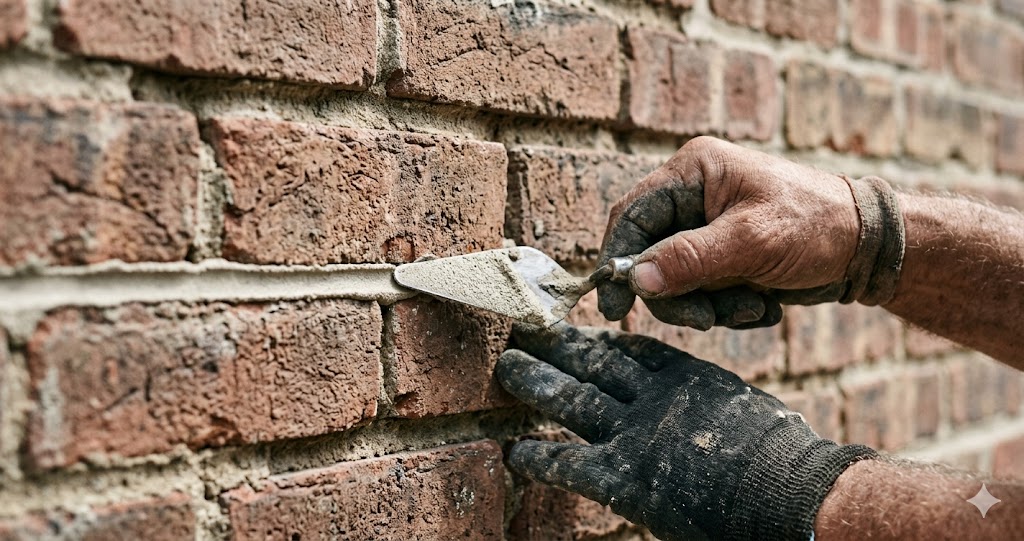
Here is the dirty secret of bad tuckpointing in Chicago: a lot of it is not tuckpointing at all. It is surface parging - somebody coming in with fresh mortar and slapping it over the old, failed mortar without removing anything.
It looks fine. For about a year.
Real tuckpointing services involve grinding out the old, deteriorating mortar joints to a depth of at least three-quarters of an inch - sometimes more, depending on joint condition. Less than that, the new mortar has nothing to grip. Mortar depth requirements are not arbitrary; they give the repair its mechanical bond and its lifespan. A properly tuckpointed Chicago building can hold for 25 to 30 years. A smear job will fail before the check clears.
How do you know which one you are getting? Ask:
- “How deep will you grind the joints?”
- “Are you using an angle grinder or just a chisel?”
- “What’s the joint profile when you’re done - concave, V-tooled, weather struck?”
- “Will the new mortar match the existing color and texture?”
A contractor who can not answer those questions in plain English is not the contractor you want on your building. Hand-tooled mortar joints, matched in color and depth, is what good Chicago tuckpointing looks like. Done right, it is the single best step toward preventing future mortar damage and protecting against freeze-thaw mortar damage.
This is also where the difference between tuckpointing and repointing comes up. In Chicago trade usage, they are functionally the same. Do not let a salesman use “repointing” to imply it is cheaper or different work. Mortar joint deterioration gets the same treatment either way.
If you are not sure whether your building needs full tuckpointing or just spot repair, request an estimate from us. We will walk the building with you and tell you straight - even if the honest answer is “you can wait another year.”
6. Who Is Actually Going to Be on My Property?
This one matters more than people think. A lot of masonry companies in Chicago carry a small office staff and subcontract the real labor. Sometimes that crew is great. Sometimes they are a different company entirely, with their own insurance and quality standards.
Subcontracting is not always bad. But you have a right to know whose hands will be on your brick.
At Fortune Restoration, our crews are ours. Field Superintendent Dan Stojak - EPA RRP certified, lead-safe certified, OSHA-trained - runs the job sites directly. Bernie Halloran is our Senior Estimator and walks every estimate in person. The Fortune name has been on the truck since my dad and uncles started the company.
Ask: Is this your crew? Who is the supervisor on site? Who do I call if I see something that concerns me? If the answers are vague, that is your answer.
7. What Is the Warranty - and What Does It Actually Cover?
A masonry contractor warranty is only as good as the contractor still being around to honor it. So the warranty question is really two: what does it cover, and how confident are you that this company will still be in business five years from now?
A real warranty on exterior masonry repair, tuckpointing, or brick wall repair in Chicago should cover the workmanship for at least two years. Some shops offer longer - five, even ten years on certain scopes. The longer the warranty, the more skin the contractor has in the game.
Read the document. Find out what is excluded. Some warranties exclude “acts of nature” so broadly that a hard winter voids them - which in Chicago is every winter. Masonry contractor warranties that do not cover freeze-thaw mortar damage in this climate are not really warranties.
Also ask about response time. “We will get to it eventually” and “within 30 days” are very different commitments.
Our own warranty has not changed since the 80s: if our work fails because of how we built it, we come back and fix it. Period. Four decades in the same city, under the same family name, means we can not afford to make promises we will not keep.
Want a clear warranty on Chicago masonry work? Request an estimate from us and you will get the scope, the schedule, and the warranty terms in writing - no fine print, no surprises.
8. Will You Pull the Permit, or Am I Doing It?
For most structural masonry repair in Chicago - including lintel replacement, parapet wall repair, and any work over a certain scope - the City of Chicago requires a permit. Chicago building code masonry requirements are not optional. They exist because a chunk of brick falling from a parapet onto the sidewalk is a real risk.
A licensed masonry contractor pulls the permit. If a contractor asks you to pull it yourself - or worse, suggests skipping it - that is a red flag. They are either not licensed, or trying to dodge inspection.
The permit costs more than a few bucks and adds a few days to the timeline. It also gives you an independent city inspector verifying the work meets code - a layer of protection you do not want to skip.
Masonry permits Chicago requires are part of what we do for every job that needs one. So is meeting code on parapet wall repair, mortar joint repair, lintel replacement, chimney repair, and chimney masonry repair.
9. Can I Get a Written, Itemized Estimate?
Last question. Maybe the most important one.
A real masonry contractor in Chicago will give you a written estimate that itemizes the work: square footage, joint depth, mortar type, surface prep, scaffold or staging costs, permit fees, cleanup, and warranty terms. The estimate should be specific enough to compare to other bids side by side.
If you are getting a one-page proposal with a single line that says “Masonry Repair - $14,200,” that is not an estimate. That is a guess somebody wrote on a notepad. You have no way to know what you are buying, and the contractor has every chance to scope-creep the job later.
Factors that affect masonry pricing in Chicago include:
- Scaffold or boom lift requirements (often the biggest cost variable)
- Joint linear footage and average depth of repair
- Mortar type - lime-based custom blends cost more than standard Type N
- Brick repair vs replacement cost - whether replacement is included or billed separately
- Surface prep, cleaning, and waterproofing add-ons (including breathable masonry sealers where appropriate)
- Chimney work add-ons like chimney crown repair or rusted steel lintels needing replacement
- Permit fees and timeline
- Lead paint considerations on pre-1978 buildings (the EPA RRP rule applies)
A solid estimate addresses all of these. A vague one hides them. Average tuckpointing cost in Chicago varies widely based on these factors, so anyone giving you a flat number without walking the building is not really giving you a number - they are giving you a hope.
For a clear, itemized written estimate on your Chicago masonry repair or tuckpointing project, request an estimate from us. We walk every building before we quote it.
Key Takeaways
- Verify license, bond, and insurance before signing. This transfers liability off your property.
- Mortar mix matters. Pre-1930 Chicago buildings need softer, lime-rich mortar - not modern Portland cement.
- Real tuckpointing means grinding joints to at least three-quarters of an inch. Surface smearing fails within a year.
- Confirm whose crew is doing the work. Subcontracted labor can mean different insurance and quality standards.
- Demand a workmanship warranty of at least two years, with explicit freeze-thaw mortar damage coverage.
- A licensed masonry contractor pulls the permit. No exceptions for structural work in Chicago.
- Get an itemized written estimate. A single-line proposal hides the scope and invites scope-creep.
Frequently Asked Questions About Hiring a Masonry Contractor in Chicago
How long does tuckpointing last in Chicago?
A properly done tuckpointing job in Chicago should last 25 to 30 years on most exposures. South and west-facing walls take more freeze-thaw punishment and may need attention sooner. Tuckpointing lifespan depends almost entirely on the quality of the original work - grinding depth, mortar mix, and joint tooling - which is why hiring the right masonry contractor matters more than anything else.
How can I tell if mortar is failing?
Watch for gaps or recessed mortar joints, sandy or crumbling mortar that scratches out with a key, white efflorescence on brick (meaning water penetration in brick walls), and stair-step cracks running diagonally across the brick pattern. If you see any two of these, it is time to bring in a masonry contractor for an inspection. These are the most reliable signs your brick needs tuckpointing.
Can you DIY tuckpointing?
For a small, low-elevation, easily accessible section, a careful homeowner can do touch-up work. For anything above the first floor, anything structural, or anything on a historic building - no. The grinding equipment, mortar matching, joint tooling, and safety considerations at height are not DIY territory.
Is cracked brick dangerous?
It can be. A single hairline crack in one brick is usually cosmetic. But stair-step cracks across multiple bricks, displacement at the corners of a window or door, bulging or bowing walls, or spalling brick at parapet level are structural concerns. Falling brick from a Chicago parapet is one of the most common citywide hazards. When in doubt, get a masonry inspection.
What is the best time of year for tuckpointing in Chicago?
Spring through early fall - late April through October - is the working window. Mortar needs temperatures above 40 degrees to cure properly, and ideally above 50. We do not tuckpoint in freezing conditions. The mortar will not hydrate correctly and the repair will fail. Booking early is smart, because the good crews fill up by May.
How much does tuckpointing cost in Chicago?
It varies widely. A small chimney tuckpointing job might run $500 to $2,500. A full elevation on a Chicago two-flat runs $4,000 to $15,000 depending on access, scope, and mortar. The biggest cost driver is scaffold access - anything above two stories adds significant staging costs. Be skeptical of any number quoted without somebody walking the building first.
What happens if you don’t fix failing mortar?
Water moves through the wall instead of around it. The damage compounds: spalled brick faces, rotted internal framing, efflorescence on brick interiors, eventual structural issues. The cost of delaying masonry repairs is almost always higher than doing them on schedule. Does masonry repair increase home value? Yes - and neglected masonry actively decreases it.

Hiring the Right Masonry Contractor Is the Whole Job
The work itself is hard. Picking the right contractor is harder. Get this right and the masonry on your Chicago building holds for a generation. Get it wrong, and you pay twice or three times to undo it.
We have been doing this in Chicago since 1979. Licensed. Bonded. Insured. Family-run. Same name on the truck. Same standards on the wall.
If you want to talk through a project - masonry repair, tuckpointing, chimney repair, lintel replacement, brick replacement, or anything else - we would be glad to walk the building with you. Read our recent post on signs your brick house is begging for tuckpointing, and request an estimate from us when you are ready.